


 English
  中文简体
中文简体  русский
  Español
  عربى
عربى  Français
  Português
  Deutsch
  Türk
Türk
JINYE
JINYE
JINYE
JINYE
JINYE
JINYE
JINYE
JINYE
JINYE
JINYE
JINYE
JINYE
JINYE
JINYE
JINYE
JINYE

What is the working principle of an Controllable Pitch Propeller?
A Controllable Pitch Propeller (CPP) works by rotating each propeller blade around its own longitudinal axis while the shaft continues spinning at a constant speed. This rotation changes the angle at which the blade meets the water — known as the pitch angle — which directly controls how much thrust is generated and in which direction. By continuously varying this angle through a hydraulic servo mechanism housed inside the hub, the propulsion system can deliver any thrust level from full ahead to full astern without ever changing the engine speed or stopping the shaft.
In essence: the engine sets the rotational energy, and the blade pitch determines what the propeller does with it. This separation of speed control from thrust control is what makes the CPP fundamentally different from a fixed-pitch system — and what gives it its performance advantages in terms of fuel efficiency, maneuverability, and operational flexibility.
The Hydrodynamic Foundation: How Pitch Creates Thrust
To understand why changing pitch angle controls thrust, it helps to understand the hydrodynamics of a propeller blade. Each blade acts as a rotating hydrofoil. As it moves through water, the curved leading face creates a region of lower pressure on one side and higher pressure on the other, generating lift — and it is this lift force, resolved in the direction of shaft rotation and vessel travel, that produces thrust and torque.
The pitch angle (also called the blade angle or setting angle) defines the angle between the blade chord line and the plane of rotation. When this angle is increased, the blade presents more surface area to the oncoming water flow, increasing the pressure differential and generating more thrust. When the angle is reduced toward zero, the blade becomes nearly parallel to the water flow and produces almost no thrust — the so-called feathered or zero-pitch condition. When the angle passes through zero into negative territory, the pressure differential reverses, and the propeller generates astern thrust.
On a typical large CPP installation, the full pitch range spans from approximately +35° (full ahead) through 0° (zero thrust) to approximately −28° (full astern). The entire sweep from maximum ahead to maximum astern is achievable in 15 to 30 seconds on most modern systems, compared to several minutes required for a conventional engine reversal sequence.
Internal Hub Mechanism: How the Blade Angle Is Changed
The pitch-change mechanism is the heart of a CPP system. All critical components are housed within the rotating hub, which must remain completely watertight while transmitting both rotational torque from the shaft and pitch-changing forces from the hydraulic system.
Blade Trunnion and Mounting Flange
Each propeller blade is not rigidly bolted to the hub as in a fixed-pitch system. Instead, each blade is mounted on a trunnion bearing — a precisely machined cylindrical journal that allows the blade to rotate freely around its own radial axis. The blade root features a flanged foot that sits on the trunnion, and large-diameter bearing rings (typically plain or roller bearings in bronze or stainless steel) carry the full centrifugal and hydrodynamic loads while permitting smooth rotation. The bearing diameter on a large ship CPP can exceed 600 mm, and the system must withstand centrifugal forces that approach several hundred kilonewtons per blade at full shaft speed.
Crosshead and Crank Pin Linkage
Inside the hub body, each blade trunnion is connected to a central sliding component called the crosshead (also called the sliding block or piston rod extension) via a crank pin and connecting rod arrangement. This converts the linear axial movement of the crosshead into rotational movement at the blade trunnion. When the crosshead moves forward along the shaft axis, all blades simultaneously rotate in one direction; when it moves aft, all blades rotate the other way. The geometry of the crank pin offset and connecting rod length determines the pitch-change rate — typically designed so that the full pitch range is covered by a crosshead travel of 150 to 400 mm, depending on the hub size.
Servo Piston and Hydraulic Actuation
The crosshead is driven by a hydraulic servo piston, which is the actuating element of the entire pitch-change system. On most designs, the servo piston runs inside a cylinder bore within the hub body itself, or in a separate servo unit mounted aft of the hub. Pressurized hydraulic oil is delivered to either side of the piston through axial passages bored through the hollow propeller shaft. Increasing pressure on the forward face of the piston pushes the crosshead forward, rotating blades toward ahead pitch; increasing pressure on the aft face reverses the motion toward astern pitch.
The hydraulic operating pressure in typical CPP systems ranges from 100 to 250 bar, and the oil flow during a pitch change is precisely metered by a servo control valve that responds to pitch command signals from the bridge. The oil used in the hub is typically a marine hydraulic oil with anti-corrosion and anti-wear additives, fully compatible with the nylon-aluminum-bronze internal components.
Oil Distribution Box: Connecting the Rotating Shaft to the Fixed Hydraulic System
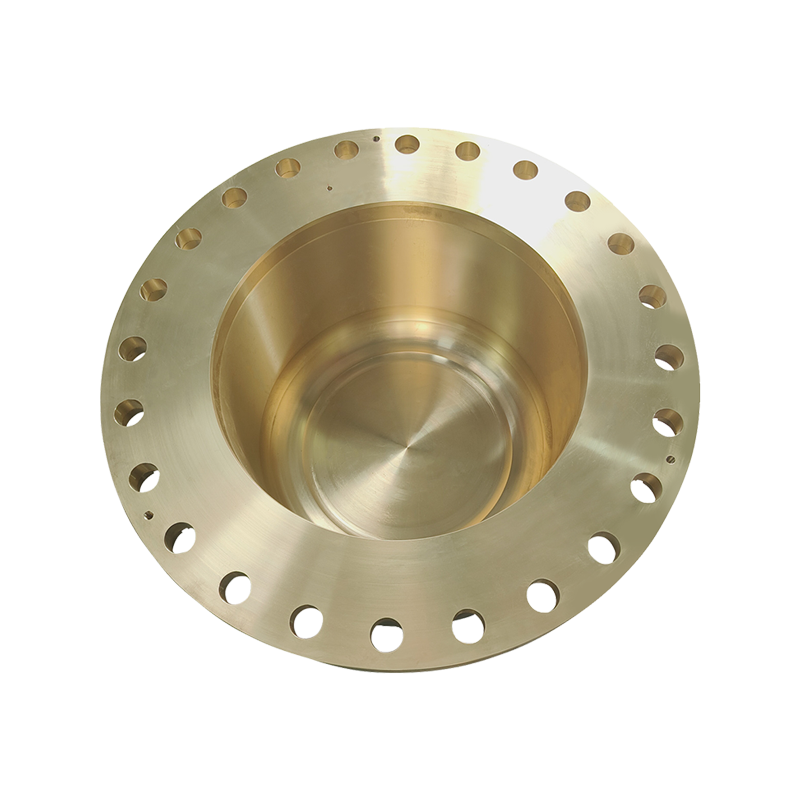
One of the most critical engineering challenges in CPP design is delivering hydraulic oil to a mechanism that rotates continuously inside the hub. This is solved by the oil distribution box (OD box), also known as the transfer tube or rotary union, installed on the fixed (non-rotating) part of the propulsion system — typically at the after end of the gearbox or at the thrust bearing housing.
The OD box contains a stationary outer housing and a rotating inner sleeve that is keyed to the propeller shaft. The two elements are separated by precision-fitted annular oil galleries and sealing rings that allow pressurized oil to pass from the fixed hydraulic circuit into the rotating shaft passages — and return oil to flow back out — without leakage, even as the shaft rotates at 100 to 600 RPM. Two or three separate oil passages are typically maintained: one for ahead pitch pressure, one for astern pitch pressure, and one for hub lubrication and drain.
The OD box seals are one of the highest-wear components in the CPP system and require inspection at every drydock interval (typically every 2.5 to 5 years). On modern designs, wear-compensating seal arrangements and condition monitoring through oil loss sensors extend the reliable service intervals and provide advance warning of developing seal deterioration.
The Hydraulic Power Unit: Generating and Controlling Oil Pressure
The hydraulic power unit (HPU) is the shore-side engineering heart of the CPP system, typically located in the engine room adjacent to the gearbox or engine. It supplies, filters, and pressure-regulates the hydraulic oil that actuates the servo piston.
HPU Components and Function
A standard HPU for a medium-sized CPP installation includes:
- Hydraulic pumps: Usually two or more variable-displacement axial piston pumps, one running as the duty pump and one on standby. Each pump is typically capable of delivering 40 to 200 liters per minute at working pressure, depending on the hub size and required pitch-change speed.
- Servo control valve: An electro-hydraulic proportional valve or servo valve that translates the electronic pitch command signal into a precise oil flow rate to one side of the servo piston. Modern servo valves have response times of less than 100 milliseconds, enabling rapid and accurate pitch modulation.
- Oil reservoir and filtration: A dedicated tank (typically 200 to 1,000 liters) with high-pressure filters (typically rated at 10 microns or finer) to protect servo valve components from contamination-induced wear and failure.
- Pressure accumulators: Nitrogen-charged bladder accumulators that store pressurized oil to supply emergency pitch-change capability in the event of pump failure, ensuring the vessel retains at least limited maneuverability.
- Oil cooler and temperature control: The hydraulic oil is continuously circulated through a seawater or freshwater cooler to maintain operating temperature typically between 40°C and 60°C, preventing thermal degradation of seals and oil viscosity changes that would affect pitch response accuracy.
Redundancy Arrangements
Class society rules for vessels where propulsion loss would create a safety hazard (ferries, tankers, icebreakers) typically require full hydraulic system redundancy. This means duplicated pump sets, duplicated control valve trains, and independent electrical supply circuits, so that a single component failure does not result in loss of pitch control. If hydraulic pressure is lost entirely, most CPP designs incorporate a mechanical lock-up that holds the blades at their last commanded pitch, effectively converting the system into a fixed-pitch propeller for emergency operation.
Control System: From Bridge Command to Blade Movement
The control system is what transforms a helmsman's lever movement on the bridge into a precise blade angle change at the propeller hub. Modern CPP control systems are fully electronic and typically integrated with the vessel's automation and engine control systems.
Combined Control Lever
On most CPP-equipped vessels, a single combined control lever (CCL) on the bridge simultaneously commands both engine speed (RPM) and propeller pitch according to a pre-programmed combinator curve. Moving the lever forward increases pitch and, if the combinator calls for it, also increases engine RPM — but the relationship between RPM and pitch is optimized for fuel efficiency rather than simply proportional. This combinator control strategy is one of the key mechanisms by which CPP systems achieve fuel savings over FPP arrangements, because it keeps the engine close to its minimum specific fuel oil consumption (SFOC) operating point across the full vessel speed range.
Pitch Feedback and Closed-Loop Control
The actual pitch angle is measured continuously by a pitch feedback sensor — typically a linear variable differential transformer (LVDT) or rotary encoder — mounted on the crosshead or servo piston rod. This feedback signal is compared with the commanded pitch in a closed-loop controller (typically a PID algorithm), and any deviation is corrected by adjusting the servo valve. The result is pitch positioning accuracy typically within ±0.1° to ±0.3° of the commanded angle, even under the varying hydrodynamic loads that act on the blades during operation.
Control Stations and Redundancy
CPP control is typically available from multiple stations: the main bridge, the bridge wings (for port maneuvering), the engine control room, and a local emergency panel at the HPU itself. Classification rules generally require that pitch control must remain operable from at least two independent stations, and that the local HPU panel must always be capable of commanding pitch movement regardless of the status of upper-level control electronics. This layered redundancy ensures that pitch control is never lost due to a single electronic failure.
Operating States: Ahead, Astern, Zero Pitch, and Feathered
Understanding the four primary pitch states clarifies how a CPP manages thrust across all operating conditions:
| Pitch State | Typical Angle | Thrust Output | Typical Use Case |
|---|---|---|---|
| Full Ahead | +30° to +35° | Maximum forward | Ocean transit at design speed |
| Partial Ahead | +10° to +25° | Reduced forward | Slow steaming, harbor approach |
| Zero / Feathered | 0° to ±2° | None (minimal drag) | Drift, shaft generator only |
| Partial Astern | -10° to -20° | Reduced astern | Braking, controlled approach |
| Full Astern | -25° to -30° | Maximum astern | Emergency stop, crash stop maneuver |
The feathered state deserves special mention. When set to zero pitch, the blades present their minimum cross-section to the water flow, dramatically reducing drag on the rotating assembly. In twin-screw vessels, one shaft can be feathered and locked while the other provides propulsion — reducing fuel consumption by approximately 8–12% compared to dragging a windmilling fixed-pitch propeller at low speed.
The Combinator Curve: Optimizing Engine and Pitch Together
One of the most powerful features of a modern CPP control system is the combinator curve — a programmed relationship between the bridge lever position, engine RPM command, and pitch angle command that is encoded into the control system at the vessel commissioning stage.
Rather than simply commanding maximum pitch and maximum RPM for maximum thrust (which would be inefficient at intermediate speeds), the combinator curve specifies, for each lever position, the combination of RPM and pitch that delivers the required thrust at the lowest possible fuel consumption. Typically this means:
- At low thrust demands (slow speed), pitch is reduced while RPM is held at or near the engine's most fuel-efficient operating point.
- As thrust demand increases, pitch increases first, before RPM is raised — keeping the engine at low SFOC for as long as possible.
- Only at high thrust demands does RPM increase toward rated speed, with pitch set to the angle that produces maximum propulsive efficiency at that RPM.
The combinator curve is typically developed using computational fluid dynamics (CFD) models of the propeller and engine performance data from the manufacturer, then fine-tuned during sea trials. A well-optimized combinator can deliver fuel savings of 5–12% over the operating cycle compared to a simple proportional RPM-and-pitch control law.
How CPP Reduces Cavitation Through Pitch Control
Cavitation occurs when local water pressure at a propeller blade surface drops below the vapor pressure of water, causing water to vaporize and form vapor-filled bubbles. When these bubbles collapse as they move into higher-pressure regions, they generate intense local pressure pulses — causing blade erosion, noise, vibration, and efficiency loss.
The primary cause of cavitation in propellers is off-design operation — when the blade angle of attack deviates significantly from the value the blade was designed for, local pressure gradients intensify. A fixed-pitch propeller is highly susceptible to this at any speed other than its design speed.
A CPP avoids this by continuously adjusting pitch to maintain the optimal blade angle of attack at whatever speed the vessel is traveling. The blade always operates near its design point regardless of the shaft RPM or vessel speed, keeping local pressure minima well above the cavitation threshold. Operational measurements on CPP-equipped ferries and naval vessels have documented cavitation noise reductions of 3 to 8 dB compared to equivalent fixed-pitch installations, along with substantially reduced blade surface erosion rates and longer intervals between blade reconditioning operations.
CPP in Dynamic Positioning: Continuous Real-Time Pitch Modulation
Dynamic positioning (DP) systems use a combination of propellers, thrusters, and sophisticated control software to hold a vessel in a fixed position at sea despite wind, waves, and current forces. The propulsion actuators must respond rapidly and precisely to continuously changing thrust demand signals from the DP computer.
CPP is particularly well suited to DP operation because:
- Pitch response is fast: A pitch change command from the DP system results in measurable blade movement in under one second for small adjustments, with the full pitch range traversable in 15–30 seconds.
- Thrust modulation is smooth: Because no engine speed change is involved, thrust increases and decreases are smooth and continuous, without the torque transients associated with engine acceleration and deceleration.
- Zero-thrust is achievable: The DP system can command zero pitch, delivering exactly zero thrust without idling the engine or creating uncontrolled residual thrust from windmilling.
- Engine loading is stable: The main engine runs at constant speed regardless of DP pitch commands, avoiding thermal cycling, speed governor hunting, and fuel injection transients that reduce engine reliability in long DP operations.
Offshore supply vessels, dive support ships, cable-laying vessels, and floating production platforms all rely on CPP-driven propulsion for DP operations, where position-keeping accuracy of ±0.5 to ±2.0 meters is routinely required in sea states up to significant wave heights of 4–5 meters.
Mechanical Load Management: Protecting the Engine Through Pitch
One important but often overlooked function of the CPP control system is engine load protection. In heavy weather, when a vessel pitches and the propeller intermittently emerges from or races in aerated water, the load on the propeller can swing violently — causing the engine to over-speed or overload in rapid succession.
A CPP system can counteract this automatically. The control system monitors engine shaft torque (via torsion meters or calculated from fuel injection data) and automatically reduces pitch when torque exceeds a preset limit, preventing engine overload. Conversely, if propeller ventilation causes sudden torque loss and engine over-speed, pitch is increased rapidly to restore load. This torque-limiting pitch control function is particularly valuable for:
- Icebreakers operating in variable ice concentration, where resistance can change by a factor of 5 to 10 within seconds as ice floes are encountered and broken.
- Trawlers transitioning between trawling and free-steaming, where propeller resistance changes dramatically as the trawl gear is deployed or hauled.
- Any vessel operating in rough seas where propeller emergence and re-entry creates cyclic loading that would otherwise stress both the propulsion shafting and the engine itself.
By actively managing propeller load, the CPP system effectively extends engine and gearbox service life and reduces the frequency of load-induced component fatigue failures.
CPP System Components: Summary Overview
The complete CPP propulsion system integrates multiple subsystems that must work in precise coordination. The table below summarizes all major components and their functions:
| Component | Location | Function | Key Parameter |
|---|---|---|---|
| Propeller blades | Hub exterior | Generate hydrodynamic thrust | Pitch range: -28° to +35° |
| Trunnion bearings | Hub body | Support blade rotation under load | Diameter up to 600+ mm |
| Crosshead / sliding block | Hub interior | Convert linear piston motion to blade angle | Axial travel: 150-400 mm |
| Servo piston | Hub / servo unit | Actuate crosshead via hydraulic | Operating pressure: 100-250 bar |
| Oil distribution box | Shaft / gearbox aft end | Transfer oil between fixed and rotating | 2-3 isolated oil galleries |
| Hydraulic power unit | Engine room | Supply, filter, and pressure-regulate | Flow: 40-200 L/min |
| Servo control valve | HPU / valve panel | Meter oil flow to piston per pitch | Response time: <100 ms |
| Pitch feedback sensor | Crosshead / hub | Measure actual pitch for closed-loop | Accuracy: ±0.1° to ±0.3° |
| Combined control lever | Bridge | Command RPM and pitch via combinator | Single-lever operation |
| Pressure accumulator | HPU | Store emergency pressure for pitch | Nitrogen pre-charge |
Maintenance Implications of the CPP Working Principle
Because the CPP works through a combination of high-pressure hydraulics, precision mechanical linkages, and rotating seals — all operating in a seawater environment — its maintenance requirements are considerably more involved than those of a fixed-pitch propeller.
Routine Maintenance Items
- Hub oil condition monitoring: The oil inside the rotating hub must be sampled and analyzed for water contamination and metal particle content at regular intervals — typically every 3 to 6 months. Water ingress through worn hub seals is the earliest warning sign of impending seal failure.
- OD box seal inspection: At drydock (every 2.5 to 5 years), the oil distribution box seals are inspected and replaced as a precautionary measure, regardless of apparent condition. Unexpected seal failure at sea can result in hydraulic oil loss and loss of pitch control.
- Blade bearing clearance measurement: Trunnion bearing wear increases blade root clearance over time, leading to increased vibration and eventually to imprecise pitch positioning. Clearance measurements are taken at every drydock and must remain within manufacturer-specified limits, typically 0.1 to 0.5 mm depending on hub size.
- Hydraulic filter replacement: HPU filters are replaced on a time or differential pressure basis — typically every 2,000 to 4,000 operating hours — to prevent contamination buildup that could damage servo valves.
- Servo valve testing and reconditioning: Servo valves are sensitive precision components. Function testing is performed annually, and full reconditioning or replacement is typically carried out every 8 to 15 years, depending on operating hours and oil cleanliness records.
Vessels with well-maintained CPP systems routinely achieve hub overhaul intervals of 10 to 15 years, with the major internal mechanism components remaining in service for the full interval between major dry-dockings when oil condition and seal integrity are diligently monitored.
PREV:What are the main advantages of FPP Fixed Pitch Propellers?
NEXT:What is the difference between a fixed-pitch propeller and an Controllable Pitch Propeller?
NEXT:What is the difference between a fixed-pitch propeller and an Controllable Pitch Propeller?
Interested in working together or need more info?
Related products
Get in Touch Now!
We're Here to Assist with
All Your Requirements
© Copyright Zhenjiang Jinye Propeller Co.,Ltd. All Rights Reserved. China Marine Copper Propeller Manufacturers Custom Marine Propeller Factory
