


 English
  中文简体
中文简体  русский
  Español
  عربى
عربى  Français
  Português
  Deutsch
  Türk
Türk
JINYE
JINYE
JINYE
JINYE
JINYE
JINYE
JINYE
JINYE
JINYE
JINYE
JINYE
JINYE
JINYE
JINYE
JINYE
JINYE

What is a Controllable Pitch Propeller?
In modern ship propulsion systems, propellers play a crucial role. While traditional fixed-pitch propellers (FPPs) are simple in structure, their performance under different operating conditions often suffers. To achieve higher fuel efficiency and superior ship maneuverability, a more complex propulsion device was developed: the Controllable Pitch Propeller (CPP).
1. What is a Controllable Pitch Propeller?
A controllable pitch propeller is a special type of marine propulsion device. Its core characteristic is that the pitch of the propeller blades can be changed and adjusted as needed during ship navigation.
- Fixed-pitch propeller (FPP): The blades and hub are fixedly connected, and the pitch (the theoretical distance propelled by one revolution of the blades) is constant. Changes in ship speed primarily depend on adjustments to the main engine speed, and cannot alter the angle of attack of the propeller blades.
- Adjustable Pitch Propeller (CPP): The blades are mounted on the hub via a complex hydraulic or mechanical mechanism. The crew can continuously adjust the pitch by changing the angle of the blades relative to the hub through a control system in the cockpit, even down to zero or negative pitch.
2. Working Principle of Adjustable Pitch Propellers
The core of an adjustable pitch propeller lies in its internal pitch adjustment mechanism.
Hydraulic Drive is Key
Most CPP systems use hydraulic drive. High-pressure oil is delivered to the hub through the Oil Distribution Box (ODB) in the central bore of the propeller shaft. The hydraulic oil drives a piston, and the piston's movement is converted into blade rotation via a connecting rod or pin mechanism, thus changing the blade pitch.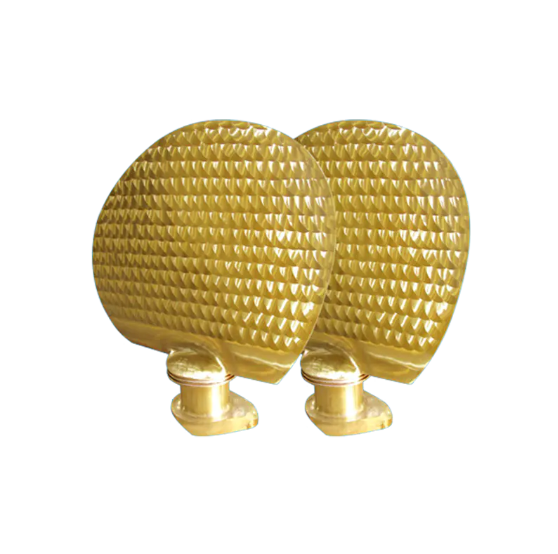
Relationship between Pitch and Thrust
By adjusting the pitch, the hydrodynamic angle of attack of the blades can be directly changed, thereby controlling the thrust generated by the propeller:
- Forward Gear: Increasing the positive pitch increases thrust and increases ship speed.
- Reverse Gear: Adjusted to negative pitch, thrust reverses, and the ship reverses without requiring main engine reversing.
- Neutral Gear: Adjusted to zero pitch, thrust is zero, and the main engine maintains a constant speed.
3. Advantages and Applications of Adjustable Pitch Propellers
Although adjustable pitch propellers are complex in structure and more expensive, their significant advantages have led to their widespread use in demanding vessels.
Higher Fuel Efficiency
The thrust required by a ship varies under different speeds, drafts, and sea conditions. The CPP can be adjusted at any time to match the main engine power output and sailing resistance, ensuring the main engine always operates in the most economical speed and load range, greatly improving overall fuel efficiency.
Superior Ship Maneuverability
This is one of the most important advantages of the CPP. It provides fast and precise thrust control, especially in ports, narrow waterways, or during dynamic positioning (DP) operations:
- Quick Reversing: A simple change in pitch allows for a transition from full forward speed to full reverse speed without waiting for the main engine speed to decrease or reversing.
- Precise low-speed control: While maintaining high main engine speed to provide sufficient auxiliary power (such as generators and pumps), precise speed control is achieved through fine-tuning the propeller pitch.
Wide Range of Applications
Due to these advantages, adjustable-pitch propellers are commonly used in vessels with high maneuverability or efficiency requirements, such as tugboats, ro-ro passenger ships, research vessels, naval vessels, and ships using gas turbine propulsion.
The Controllable Pitch Propeller is a significant milestone in the development of marine propulsion technology. By allowing dynamic adjustment of the propeller blade pitch, it successfully resolves the conflicting demands for efficiency and maneuverability under different operating conditions.
Interested in working together or need more info?
Related products
Get in Touch Now!
We're Here to Assist with
All Your Requirements
© Copyright Zhenjiang Jinye Propeller Co.,Ltd. All Rights Reserved. China Marine Copper Propeller Manufacturers Custom Marine Propeller Factory
