


 English
  中文简体
中文简体  русский
  Español
  عربى
عربى  Français
  Português
  Deutsch
  Türk
Türk
JINYE
JINYE
JINYE
JINYE
JINYE
JINYE
JINYE
JINYE
JINYE
JINYE
JINYE
JINYE
JINYE
JINYE
JINYE
JINYE

How does a controllable pitch propeller (CPP) work?
In modern marine propulsion systems, CPPs have become core equipment for improving ship maneuverability and fuel economy. Unlike traditional fixed-pitch propellers (FPPs), controllable pitch propeller systems allow ships to change thrust by adjusting the blade angle without changing the main engine speed or direction of rotation.
What is a CPP?
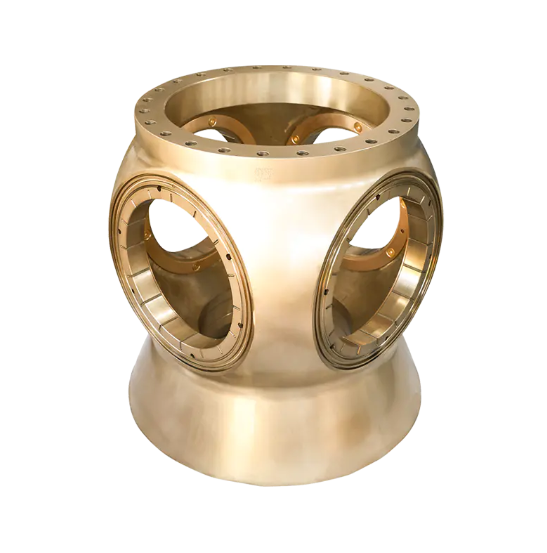
A CPP is a special type of marine propulsion unit whose blades are mounted on a hub and can rotate around its axis. Through a complex hydraulic or mechanical mechanism, the crew can change the "pitch angle" of the blades in real time according to navigation needs.
How a CPP Works
The core of a CPP lies in its pitch-changing mechanism. Its workflow typically consists of the following key steps:
1. Control Command Input
The control levers on the bridge (bridge) issue commands to change speed or direction. This signal is transmitted to the hydraulic control unit (HPU) in the engine room.
2. Hydraulic Transmission System
Most controllable pitch propeller systems use hydraulic oil as their power medium. High-pressure oil enters a hydraulic cylinder located inside the hub through the hollow propeller shaft.
3. Mechanical Linkage Pitch Change
The piston inside the hydraulic cylinder moves with the oil pressure, driving a connecting rod or slider mechanism inside the hub. These mechanisms are connected to the root of the blades, forcing the blades to rotate synchronously within the hub, thus changing the pitch:
- Positive Pitch: Generates forward thrust.
- Zero Pitch: The propeller rotates but does not generate thrust (similar to neutral).
- Negative Pitch: Generates reverse thrust without requiring the main engine to reverse.
Comparison of controllable pitch propeller (CPP) and Fixed Pitch Propellers (FPP)
Maneuverability and Response Speed
controllable pitch propeller systems have an overwhelming advantage in maneuverability. Because they can achieve forward, stop, and reverse movement by directly changing the blade angle, the ship's dynamic response is extremely rapid. In contrast, fixed-pitch propellers require stopping the main engine before reversing, a cumbersome and time-consuming process.
Propulsion Efficiency and Adaptability
Under different sailing conditions (e.g., heavy load, light load, or headwind), adjustable-pitch propellers can maintain optimal propulsion by adjusting the pitch. Fixed-pitch propellers, on the other hand, are typically optimized for a specific speed (design condition), and their propulsion efficiency drops significantly when deviating from this condition.
Main Engine Protection and Service Life
Ships using adjustable-pitch propellers do not experience the frequent and severe impacts of reversing, starting, and stopping, greatly reducing wear on internal engine components. Fixed-pitch propellers, with their frequent reversing operations, not only increase mechanical fatigue but also place higher demands on the compressed air starting system.
System Complexity and Maintenance Costs
Structurally, fixed-pitch propellers, being integrally cast or simply assembled, are very robust and require almost no maintenance. Adjustable-pitch propellers, however, integrate hydraulic systems, pistons, and linkage mechanisms, resulting in higher system complexity. This means that the initial installation cost of a CPP is higher, and regular professional maintenance of the hub seals and hydraulic oil quality is required during subsequent operation.
Why choose an adjustable pitch propeller?
- Superior maneuverability: CPPs are particularly suitable for vessels that require frequent speed changes and berthing/unberthing maneuvers, such as tugboats, ferries, and dredging vessels.
- Energy saving and emission reduction: By optimizing the matching of pitch and speed (joint control mode), controllable pitch propeller allow the main engine to always operate in the optimal fuel consumption range.
- Support for shaft-driven generators: Because the propeller speed can remain constant, the main engine can still drive a shaft-driven generator to provide a stable power frequency when the vessel changes speed.
controllable pitch propeller, with their high flexibility and excellent power matching capabilities, have become the preferred propulsion solution for modern medium and large-sized vessels. Although their initial investment and maintenance requirements are higher than traditional propellers, their performance in navigation safety and long-term economic benefits is irreplaceable.
PREV:Why are copper alloys, rather than stainless steel or aluminum alloys, commonly used in marine propellers?
NEXT:What is a FPP Fixed Pitch Propeller?
NEXT:What is a FPP Fixed Pitch Propeller?
Interested in working together or need more info?
Related products
Get in Touch Now!
We're Here to Assist with
All Your Requirements
© Copyright Zhenjiang Jinye Propeller Co.,Ltd. All Rights Reserved. China Marine Copper Propeller Manufacturers Custom Marine Propeller Factory
