


 English
  中文简体
中文简体  русский
  Español
  عربى
عربى  Français
  Português
  Deutsch
  Türk
Türk
JINYE
JINYE
JINYE
JINYE
JINYE
JINYE
JINYE
JINYE
JINYE
JINYE
JINYE
JINYE
JINYE
JINYE
JINYE
JINYE

How Do Propeller Energy Saving Devices Work?
Propeller Energy Saving Devices (ESDs) work by optimizing the hydrodynamic environment around a ship's propeller — either before, at, or behind the propeller plane — to reduce rotational energy losses in the slipstream, improve the uniformity of inflow, suppress cavitation, or recover rotational kinetic energy that would otherwise be wasted. The result is a measurable reduction in fuel consumption, typically ranging from 3% to 10% depending on device type, vessel class, and operating conditions, without requiring changes to the main engine or hull form.
These devices have become a cornerstone of modern ship energy efficiency strategy, appearing on large commercial vessels including oil tankers, bulk carriers, container ships, and ro-ro vessels. Understanding how they work requires a basic grasp of propeller hydrodynamics and where energy is lost during propulsion.
Where Energy Is Lost in Conventional Propulsion
To understand how ESDs save energy, it helps to first understand why energy is wasted in conventional propulsion. A ship's propeller converts shaft power into thrust by accelerating water rearward. This process involves several unavoidable but reducible sources of energy loss:
- Axial kinetic energy loss: Water accelerated rearward in the propeller slipstream carries kinetic energy that is not converted to useful thrust. This is the largest single source of propulsive inefficiency.
- Rotational (swirl) energy loss: The propeller imparts a rotational component to the slipstream water. This angular momentum represents pure energy waste — the rotating water contributes nothing to forward thrust.
- Non-uniform wake inflow: The wake field behind a ship's hull is not uniform — velocity varies circumferentially and radially. Propeller blades passing through this uneven flow experience fluctuating load, reducing efficiency and causing vibration.
- Cavitation: At high loads or in regions of low local pressure, vapor bubbles form on blade surfaces, collapsing violently and causing noise, erosion, and thrust reduction.
- Hull-propeller interaction losses: The stern wake and boundary layer create an irregular flow environment that the propeller must work through inefficiently.
Different ESD types target one or more of these loss mechanisms. No single device addresses all of them simultaneously, which is why ESDs are often used in combination for maximum effect.
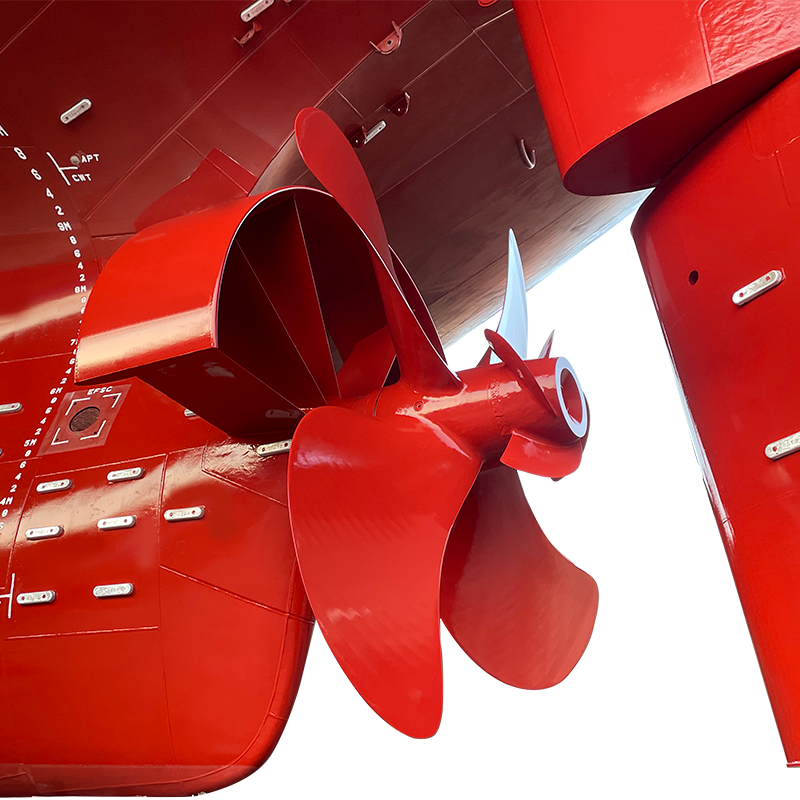
How Pre-Swirl Stators Work: Conditioning the Inflow
Pre-swirl stators (PSS) are fixed fins or guide vanes installed on the stern in front of the propeller, typically on or near the propeller shaft boss or the stern hull. They are among the most widely adopted ESDs in commercial shipping.
The working principle relies on deliberately introducing a counter-rotating swirl into the water flowing toward the propeller. When the propeller rotates, it imparts a rotational component to the water passing through it. If the incoming water already has a counter-swirl — rotating opposite to the propeller's direction of spin — then the net rotational energy in the propeller slipstream is reduced. Less rotational energy in the wake means more of the shaft power is converted to useful axial thrust rather than being wasted as angular momentum.
Design and Geometry
Pre-swirl stators typically consist of 3 to 7 fixed hydrofoil-shaped blades arranged asymmetrically around the shaft, angled to impart the correct swirl direction. The asymmetric arrangement compensates for the non-uniform velocity field in the stern wake — blades on the higher-velocity side of the hull are angled differently from those on the lower-velocity side.
Well-designed pre-swirl stators can achieve fuel savings of 4% to 8% on full-form vessels such as tankers and bulk carriers, where the slow, thick wake provides a favorable environment for swirl conditioning. On finer-form vessels such as container ships, savings are typically in the 2% to 5% range.
Secondary Benefits
Beyond direct thrust improvement, pre-swirl stators also improve the circumferential uniformity of propeller inflow. This reduces blade load fluctuations, which in turn lowers propeller-induced hull vibration and underwater radiated noise — beneficial for both vessel structural fatigue life and comfort aboard passenger vessels.
How Post-Swirl Devices Work: Recovering Rotational Energy After the Propeller
While pre-swirl devices act on the water before it reaches the propeller, post-swirl devices are installed downstream — behind the propeller — to capture the rotational kinetic energy that the propeller has already imparted to the slipstream.
Rudder Bulbs and Twisted Rudders
The ship's rudder, positioned directly behind the propeller, is ideally situated to recover swirl energy. A twisted rudder has a non-uniform cross-sectional angle along its height, shaped to match the spiral velocity field of the propeller slipstream. As the rotating wake water flows past the twisted rudder surface, it generates a net forward force component — effectively converting what would have been wasted rotational energy into additional thrust.
A rudder bulb (also called a rudder boss) is a streamlined, torpedo-shaped fairing fitted at the leading edge of the rudder, aligned with the propeller shaft centerline. It reduces the hub vortex — a low-pressure rotating core that forms at the center of the propeller slipstream and is a source of drag and noise. Rudder bulbs can recover 1% to 3% of shaft power independently, and when combined with a twisted rudder, the combined device commonly achieves 3% to 6% power savings.
Post-Swirl Stators
Some designs install fixed hydrofoil fins on the rudder or on a separate downstream boss to convert slipstream rotation into lift with a forward component. These post-swirl stators function similarly to the stator vanes in a jet engine or turbine — straightening the rotational flow and extracting useful work in the process.
How Propeller Boss Cap Fins Work: Eliminating the Hub Vortex
The propeller boss cap fins (PBCF) device is one of the simplest and most widely fitted ESDs globally. It consists of small hydrofoil-shaped fins mounted on the propeller hub cap — the conical fairing at the center rear of the propeller.
When a propeller rotates, the blades shed vortices from their tips and a concentrated hub vortex forms at the center of the slipstream. This hub vortex is a tightly wound, low-pressure core that rotates rapidly and extends far downstream. It represents both wasted kinetic energy and a source of propeller-induced erosion on downstream surfaces.
The small fins of the PBCF are angled to counter-rotate against this vortex. By injecting opposing angular momentum into the hub vortex core, they dissipate the vortex structure and reduce the rotational energy content of the near-hub slipstream. This directly reduces drag on the propeller hub and improves the pressure distribution on the blade roots.
The energy savings from PBCF alone are modest but consistent: typically 1% to 3% fuel reduction across a wide range of vessel types. Because the device is simple, lightweight, easy to retrofit, and requires no modification to the propeller or shaftline, it offers an excellent return on investment — typical payback periods of 1 to 3 years even on medium-sized vessels.
How Duct-Type Devices Work: Accelerating or Decelerating Flow
Duct-type ESDs are ring-shaped nozzles or partial ducts installed around the propeller or upstream of it. They work on a fundamentally different principle from fin-based devices: rather than modifying swirl patterns, they alter the axial velocity of water entering or leaving the propeller disk.
Accelerating Ducts (Kort Nozzles)
An accelerating duct — the classic example being the Kort nozzle — is a ring-shaped hydrofoil placed around the propeller with a converging inlet. The duct accelerates water into the propeller disk, increasing mass flow rate. This benefits heavily loaded propellers operating at low advance speeds, such as those on tugs, trawlers, and push-boats, where the propeller is working in near-bollard conditions. In these applications, the duct generates significant additional thrust from the lift on the duct itself, and can increase total bollard thrust by 20% to 30% compared to an open propeller of the same diameter.
On large ocean-going vessels operating at moderate to high speeds, accelerating ducts are less beneficial and can even add resistance. They are therefore primarily used on low-speed, high-thrust working vessels.
Pre-Duct Stators (Hybrid Duct-Fin Devices)
A more recent development is the partial pre-duct with integrated stator fins — sometimes called a vane wheel duct or energy-saving duct with guide vanes. These devices combine a partial ring (covering the lower or upper portion of the propeller disk) with integrated hydrofoil fins that simultaneously condition the flow direction and partially accelerate or decelerate the wake. They are well-suited to full-form vessels such as tankers and bulk carriers, typically delivering 3% to 7% power savings.
How Contra-Rotating Propellers Work: The Ultimate Swirl Recovery
Contra-rotating propellers (CRP) represent the most mechanically complex but hydrodynamically efficient approach to recovering rotational energy. Two propellers are mounted coaxially on concentric shafts and rotate in opposite directions — the forward propeller generates thrust and imparts a swirl to the slipstream; the rear propeller rotates in the opposite direction, converting that swirl energy into additional thrust while adding its own axial acceleration to the flow.
Because the rear propeller recovers virtually all the rotational energy lost by the front propeller, the combined system has a theoretically near-zero rotational energy loss in the slipstream. In practice, CRP systems achieve propulsive efficiency improvements of 10% to 15% compared to equivalent single-propeller installations — the highest of any ESD category.
The drawbacks are significant: CRP systems require a complex concentric shafting arrangement with a specialized gear system or a pod-drive configuration, dramatically increasing mechanical complexity, weight, and maintenance requirements. They are currently most commonly found on high-performance vessels, LNG carriers, and modern cruise ships where the efficiency gains justify the additional mechanical investment.
How Wake-Equalizing Ducts and Hull Fins Work: Improving Propeller Inflow Quality
A less obvious but important class of ESD focuses not on the propeller's immediate vicinity but on the quality of the hull wake arriving at the propeller disk. The hull wake is characteristically non-uniform: due to the three-dimensional shape of the stern, water velocity in the upper half of the propeller disk is typically lower than in the lower half, and the boundary layer near the hull centerline is thick and slow.
This non-uniformity forces propeller blades to operate at widely varying angles of attack as they rotate, reducing overall efficiency and causing periodic blade loading that generates vibration and noise.
Wake-Equalizing Ducts
A wake-equalizing duct is a partial asymmetric duct mounted on the stern hull, upstream of the propeller. It is deliberately shaped to accelerate the slow water in the upper, low-velocity region of the wake while leaving the higher-velocity lower region relatively unaffected. The result is a more uniform velocity distribution across the propeller disk — reducing the fluctuating blade loads and allowing the propeller to operate closer to its design efficiency point throughout each revolution.
Wake-equalizing ducts are particularly effective on full-block-coefficient vessels (Cb > 0.75), such as VLCCs and Suezmax tankers, where the hull form creates a severely non-uniform wake. Savings of 3% to 8% have been documented on such vessels.
Stern Hull Fins
Small fixed fins mounted on the hull just ahead of the propeller can redirect portions of the hull boundary layer away from the propeller disk centerline, reducing the thick slow-water region and improving overall wake uniformity. When carefully optimized using computational fluid dynamics (CFD), these fins can contribute 1% to 4% additional efficiency improvement, complementing other ESDs.
Comparison of Major ESD Types: Performance, Complexity, and Applicability
The table below provides a structured comparison of the major propeller energy saving device categories, summarizing their working principle, typical fuel savings, mechanical complexity, and best-suited vessel types.
| Device Type | Position | Working Principle | Typical Fuel Saving | Complexity | Best Suited Vessels |
|---|---|---|---|---|---|
| Pre-Swirl Stator | Upstream | Introduces counter-swirl to reduce slipstream rotation | 4%–8% | Low–Medium | Tankers, bulk carriers |
| Twisted Rudder + Rudder Bulb | Downstream | Recovers slipstream swirl energy; eliminates hub vortex drag | 3%–6% | Low | Container ships, tankers |
| Propeller Boss Cap Fins (PBCF) | Hub (downstream) | Dissipates hub vortex, reduces hub drag | 1%–3% | Very Low | All vessel types |
| Pre-Duct with Guide Vanes | Upstream | Conditions inflow velocity and direction simultaneously | 3%–7% | Medium | Full-form vessels |
| Wake-Equalizing Duct | Upstream (hull-mounted) | Homogenizes wake velocity distribution | 3%–8% | Low–Medium | VLCCs, Suezmax tankers |
| Contra-Rotating Propellers | At propeller plane | Second propeller recovers all rotational wake energy | 10%–15% | Very High | LNG carriers, cruise ships |
| Kort Nozzle (Accelerating Duct) | Around propeller | Increases mass flow rate; duct generates added thrust | Up to 30% bollard thrust gain | Low–Medium | Tugs, trawlers, push-boats |
The Role of CFD and Model Testing in ESD Development
Modern ESD design relies heavily on Computational Fluid Dynamics (CFD) analysis and scale-model testing in towing tanks and cavitation tunnels. These tools allow engineers to visualize the complete three-dimensional flow field around the stern and propeller, identify the specific loss mechanisms dominant for a given hull form, and optimize ESD geometry before any physical hardware is manufactured.
CFD simulations typically use Reynolds-Averaged Navier-Stokes (RANS) solvers with rotating reference frame methods to model propeller rotation. A full stern simulation including hull, ESD, propeller, and rudder can take 24 to 72 hours of computation time on a multi-core server cluster, but provides detailed data on pressure distribution, vortex structure, velocity gradients, and cavitation risk across the entire operating envelope.
Scale model tests — typically at 1:20 to 1:30 scale — provide experimental validation of CFD predictions and are required by classification societies for energy savings claims used in official vessel documentation such as the Energy Efficiency Design Index (EEDI) and the Energy Efficiency Existing Ship Index (EEXI).
The interaction between the hull wake, ESD, and propeller is highly nonlinear and vessel-specific — an ESD optimized for one hull form can actually reduce efficiency on a different vessel. This is why generic, off-the-shelf ESDs always underperform compared to custom-optimized designs tailored to the specific vessel's wake field and propeller geometry.
Combining Multiple ESDs: Synergistic Effects and Stacking Strategies
Because different ESD types target different energy loss mechanisms, they can often be combined for greater total savings — though the combined effect is generally less than the arithmetic sum of individual savings, due to interaction effects.
A commonly used combination on large tankers and bulk carriers involves:
- A pre-duct with guide vanes to condition inflow and improve wake uniformity
- A propeller boss cap fin to eliminate the hub vortex
- A twisted rudder with rudder bulb to recover remaining slipstream rotation
This three-device combination has been shown to deliver combined fuel savings of 7% to 12% on full-form vessels — significantly more than any single device alone, but less than the sum of individual savings due to the reduced remaining losses available to each downstream device.
An important consideration when stacking ESDs is that upstream devices change the flow environment for downstream devices. A pre-swirl stator that reduces slipstream rotation by 60%, for example, leaves less rotational energy for a downstream rudder bulb to recover. ESD combinations must therefore be co-designed and optimized as a system, not independently.
Regulatory Context: ESDs and International Energy Efficiency Requirements
The adoption of propeller ESDs has been strongly accelerated by international maritime regulatory frameworks. The International Maritime Organization (IMO) introduced the Energy Efficiency Design Index (EEDI) for new ships in 2013, setting mandatory minimum energy efficiency levels that tighten progressively — Phase 3 requirements, applicable from 2025 onwards, require efficiency improvements of 30% or more over the 2008 reference baseline for most vessel types.
For existing vessels, the Energy Efficiency Existing Ship Index (EEXI) and the Carbon Intensity Indicator (CII) rating system create financial and regulatory pressure to retrofit energy-saving technologies. ESDs are among the most cost-effective routes to EEXI compliance for ships already in service, as they can be installed during a scheduled dry-docking without major structural modifications.
The IMO's ambition to achieve net-zero greenhouse gas emissions from international shipping by or around 2050 means that efficiency improvements from ESDs — while not sufficient alone — form an important part of the industry's decarbonization toolkit, particularly as a bridge technology during the transition to alternative fuels.
Economic Analysis: Return on Investment for ESD Retrofits
From a shipowner's perspective, the decision to install ESDs is fundamentally an investment analysis. The key variables are installation cost, expected fuel savings, fuel price, and vessel operational profile.
A worked example for a medium-sized bulk carrier illustrates the typical economics:
- Main engine output: 8,500 kW
- Daily fuel consumption at service speed: approximately 28 tonnes per day
- Annual sea days: 250
- Fuel price: USD 600/tonne (VLSFO)
- Annual fuel cost: approximately USD 4.2 million
- ESD package (pre-duct + PBCF + twisted rudder): installation cost approximately USD 300,000–500,000
- Expected combined fuel saving: 7%
- Annual saving: approximately USD 294,000
- Simple payback period: 1.0 to 1.7 years
These figures highlight why ESD retrofits are among the most financially attractive energy efficiency investments available to shipowners — typically offering faster payback than hull coating upgrades, main engine derating, or shaft generator installations, while requiring no change to vessel operations or cargo capacity.
At higher fuel prices — which have reached USD 900–1,000/tonne for marine distillates during supply disruptions — the payback period compresses further, making ESDs even more attractive. Over a vessel's remaining service life of 10 to 20 years, cumulative fuel savings from a well-chosen ESD package can reach several million US dollars per vessel.
Limitations and Considerations When Selecting ESDs
Despite their clear benefits, ESDs are not universally applicable or always effective. Several important limitations and selection considerations apply:
Vessel-Specificity
As noted above, ESD performance is highly dependent on the specific wake field of the hull. An ESD that saves 7% on one tanker design may save only 2% — or even reduce efficiency — on a different vessel with a different stern geometry. Detailed wake measurements or CFD analysis of the specific vessel is essential before committing to an ESD investment.
Operating Speed and Load Variation
Most ESDs are optimized for a specific design speed and propeller loading condition. Vessels that operate across a wide range of speeds or frequently in ballast condition may see lower average savings than those predicted at the design point. Speed reduction programs (slow steaming), which are common in current shipping markets, also change the flow conditions around ESDs and may reduce their effectiveness.
Structural and Cavitation Risks
Poorly designed or incorrectly fitted ESDs can themselves become sources of vibration, cavitation, or structural loading on the stern. Pre-swirl stator fins, for example, must be carefully designed to avoid operating at angles of attack that induce cavitation on their own surfaces. Fatigue analysis of the fin attachments to the hull or shaft boss is essential, particularly for high-power vessels.
Maintenance and Fouling
Fin-type ESDs can accumulate marine fouling between drydocking intervals, which reduces their hydrodynamic effectiveness. Applying anti-fouling coating to ESD surfaces and including them in the hull inspection and maintenance schedule is important to preserve their long-term energy-saving performance.
Future Directions: Smart and Adaptive Energy Saving Devices
The next generation of propulsion energy saving devices is moving beyond fixed passive components toward adaptive and actively controlled systems that can respond in real time to changing sea conditions, vessel speed, and loading state.
Research programs are exploring variable-geometry stator vanes that can adjust their pitch angle under computer control, allowing the pre-swirl magnitude to be optimized continuously across the full operational speed range rather than being fixed at one design point. Early computational studies suggest that adaptive stators could recover an additional 1% to 3% of fuel beyond what fixed optimized stators achieve, simply by matching the swirl input to actual operating conditions.
Integration of ESD performance monitoring into ship energy management systems is also advancing. Shaft power meters and flow sensors installed around the stern can provide real-time data on propulsive efficiency, allowing operators to detect fouling or damage to ESDs early and take corrective action before significant efficiency losses accumulate.
As the shipping industry moves toward alternative fuels including ammonia, methanol, and hydrogen — all of which carry a significant cost premium over conventional bunkers — the importance of maximizing propulsive efficiency through devices like ESDs will only increase. Every percentage point of fuel saved through hydrodynamic optimization directly reduces the fuel cost burden of the energy transition and improves the economics of sustainable shipping.
PREV:What is the difference between a fixed-pitch propeller and an Controllable Pitch Propeller?
NEXT:What are the advantages of a Controllable Pitch Propeller?
NEXT:What are the advantages of a Controllable Pitch Propeller?
Interested in working together or need more info?
Related products

Get in Touch Now!
We're Here to Assist with
All Your Requirements
© Copyright Zhenjiang Jinye Propeller Co.,Ltd. All Rights Reserved. China Marine Copper Propeller Manufacturers Custom Marine Propeller Factory
