


 English
  中文简体
中文简体  русский
  Español
  عربى
عربى  Français
  Português
  Deutsch
  Türk
Türk
JINYE
JINYE
JINYE
JINYE
JINYE
JINYE
JINYE
JINYE
JINYE
JINYE
JINYE
JINYE
JINYE
JINYE
JINYE
JINYE

Comprehensive Analysis of Fixed Pitch Propellers (FPP)
Search
Categories
Content
- 1 I. Working Principle and Structural Design of FPP
- 2 II. Wide Range of Applications
- 3 III. Core Characteristics of FPP Products
- 4 (IV) Performance Differences and Applicable Scenarios of FPP with Different Materials
- 5 IV. How to Choose FPP Suitable for Specific Ships
- 6 (IV) Adapt to Navigation Environment and Working Conditions
- 7 V. Precautions for Using FPP
- 8 VI. Comparison of FPP with Other Similar Products
Comprehensive Analysis of Fixed Pitch Propellers (FPP)
In the vast field of marine propulsion technology, the FPP Fixed Pitch Propeller has long held a pivotal position like a shining star. As a key component of the ship's propulsion system, FPP continues to drive the vigorous development of the global shipping industry and various ship operations with its unique design and excellent performance. From the stable navigation of giant oil tankers across oceans to the flexible operations of small fishing boats in coastal waters, FPP plays an indispensable role, and its technical maturity and wide application make it a classic in the field of marine engineering.
I. Working Principle and Structural Design of FPP
The pitch of an FPP is determined during the manufacturing stage and cannot be adjusted during the ship's operation. This characteristic means that it must be precisely matched to the ship's specific navigation requirements at the initial design stage. Its working principle is based on Archimedes' spiral theory. When the propeller rotates, the blades, like a rotating inclined plane, continuously cut through the water and push the water flow backward. Specifically, each blade of the propeller presents a specific curved shape. During rotation, the blade exerts an axial thrust component and a circumferential force component on the water. The axial thrust component pushes the water backward, and according to Newton's third law, the water gives the propeller an equal and opposite reaction force, which is the core power for propelling the ship forward or backward. The circumferential force component causes the water flow to rotate, and this part of energy is usually wasted. Therefore, during design, the blade shape will be optimized to minimize this energy loss and improve propulsion efficiency.
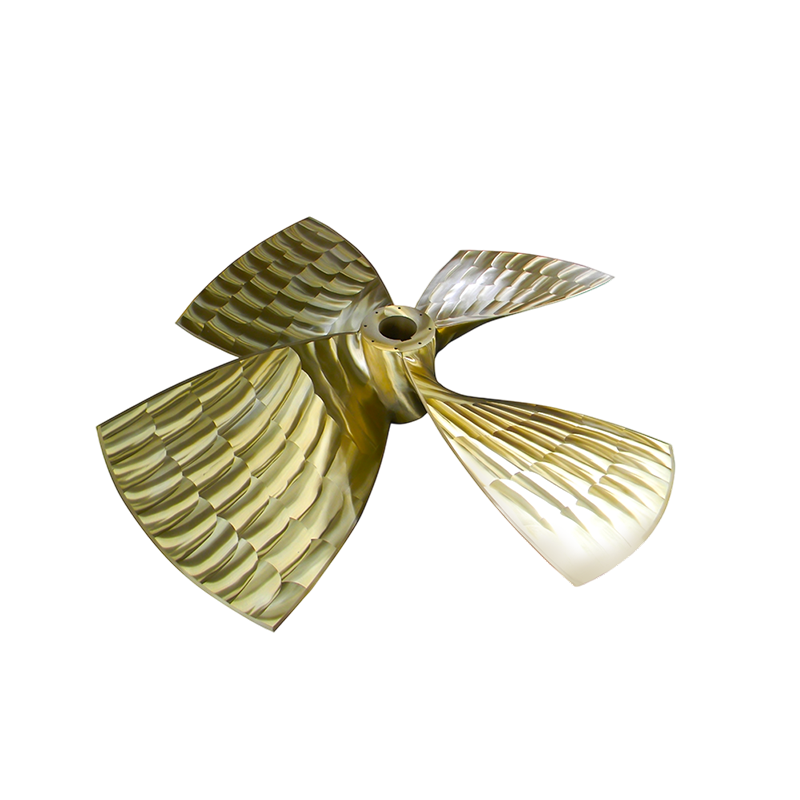
Structurally, an FPP mainly consists of a hub and blades. The hub is a key component connecting the propeller to the ship's propeller shaft. Its shape is usually cylindrical or conical, with keyways or flanges inside, which are tightly connected to the propeller shaft to ensure efficient transmission of the engine's torque to the blades. The material of the hub needs to have high strength and good toughness to withstand huge torque and the impact force of water. Common materials include forged steel and cast steel. The blades are the core part that generates thrust, and their number is usually 3 to 7. Different numbers of blades and shape designs have a significant impact on the performance of the propeller. For example, a 3-blade propeller has a relatively simple structure, light weight, and high efficiency at high speeds, making it suitable for some small speedboats or high-speed cargo ships; 4-blade and 5-blade propellers perform better in terms of balance and noise reduction and are widely used in large merchant ships and naval vessels; while 6-blade and 7-blade propellers are more commonly used in special ships that require high thrust and need to suppress cavitation, such as icebreakers. The cross-sectional shape of the blade is usually an airfoil, which can generate large lift (i.e., thrust) while reducing resistance during rotation. The length, width, twist angle, and other parameters of the blade are all precisely calculated and optimized to ensure optimal propulsion performance under design conditions. In addition, there are various ways to connect the blades to the hub, such as integral casting and welding. Integrally cast propellers have higher strength and are suitable for large ships, while welded structures are more used in small and medium-sized propellers, facilitating manufacturing and maintenance.
II. Wide Range of Applications
FPP has an extremely wide range of applications, covering many different types of ships, and its application in various fields is based on its unique performance advantages.
In the field of merchant ships, large cargo ships, oil tankers, container ships, etc., often use FPP as the propulsion device. These ships usually perform long-distance transportation at relatively stable speeds, and their navigation conditions are relatively fixed. Taking a giant oil tanker with a load capacity of hundreds of thousands of tons as an example, it mainly sails on major crude oil transportation routes around the world, with a speed generally maintained at about 15-18 knots. FPP has high efficiency under such specific rotational speed and load conditions, enabling the ship to sail stably with low fuel consumption. Statistics show that oil tankers equipped with optimally designed FPP have a fuel consumption 5%-10% lower than similar ships using other propulsion devices. For oil tankers that sail tens of thousands of nautical miles every year, this can effectively reduce operating costs, and the accumulated economic benefits are considerable. Container ships are also important application targets of FPP, especially liners that travel on fixed routes. Their navigation time and speed are strictly planned, and the stability and efficiency of FPP can ensure that they arrive at ports on time, ensuring the smooth operation of the global supply chain.
In terms of naval vessels, FPP also plays an important role. Patrol boats need to perform frequent patrol tasks in coastal areas and have high requirements for speed and reliability. FPP can provide stable thrust when traveling at high speeds, and its simple structure is convenient for maintenance on the vessel, reducing the probability of failures. As one of the main naval vessels, frigates need to perform various tasks such as anti-submarine, anti-ship, and escort. In anti-submarine operations, the advantages of FPP are particularly obvious. By optimizing the blade shape and pitch design, the occurrence of cavitation can be effectively suppressed. Cavitation refers to the phenomenon where water vaporizes to form bubbles when the pressure on the blade surface drops to a certain level as the propeller rotates, and the bubbles produce huge impact force and noise when they collapse. The optimized design of FPP can reduce the generation and collapse of cavitation, thereby reducing the noise generated by the propeller, improving the concealment of the vessel, enabling the frigate to more effectively detect and attack enemy submarines, and enhancing anti-submarine combat capabilities.
In addition, in the field of marine resource development, special ships such as offshore supply ships and scientific research ships also widely use FPP. Offshore supply ships need to supply materials to offshore oil platforms, drilling ships, etc., and often operate in shallow sea areas and complex sea conditions. FPP can be customized according to their operating characteristics to ensure good maneuverability and propulsion performance during low-speed navigation and fixed-point berthing. Marine scientific research ships need to conduct long-term scientific investigations in different sea areas and may need to perform fixed-point observation, sampling, and other operations in specific sea areas. The stability of FPP can ensure that the ship maintains a relatively fixed position in wind and waves, providing a stable working environment for researchers. For example, some scientific research ships used for deep-sea exploration are equipped with FPP that can precisely control the ship's movement at low speeds, cooperating with the detection equipment on board to complete high-precision marine data collection. Their blades adopt a special wide-chord design, which can form a more stable water flow field at low rotational speeds, ensuring that the thrust fluctuation range of the ship is controlled within 2% in the low-speed range of 0.5-3 knots. To reduce the adhesion of marine organisms, the blade surface is coated with a non-toxic anti-fouling coating containing cuprous oxide. This coating can slowly release copper ions to inhibit the adhesion of barnacles, mussels, and other organisms, so that the surface biofouling area of the propeller does not exceed 5% during 6 consecutive months of offshore operations, effectively avoiding a significant decline in propulsion efficiency. At the same time, the blade edges are rounded to reduce the water flow disturbance noise during low-speed rotation, providing a quiet environment for the observation of precision acoustic instruments on board.
III. Core Characteristics of FPP Products
(I) Performance Characteristics
Efficient Propulsion: Under the designed specific working conditions, FPP can convert engine power into ship propulsion with high efficiency. This benefits from the precise optimization of parameters such as blade shape and pitch, so that under the design speed and load conditions, the water flow can flow through the blades in the smoothest way with minimal energy loss. When the ship sails at the design speed, its propulsion efficiency can reach 60%-70%, and some optimally designed FPP can even reach more than 75%. This efficiency level is much higher than that of some propulsion devices with balanced performance under various working conditions but no outstanding advantages. For example, in the normal navigation of large cargo ships, FPP can stably maintain a high-efficiency propulsion state. Assuming that the engine power of a cargo ship is 50,000 horsepower, FPP can convert 30,000-35,000 horsepower into effective propulsion at the design speed, saving a lot of costs for long-distance transportation. Moreover, this high efficiency can be maintained during the main navigation stage of the ship and will not drop significantly due to minor changes in working conditions.
Strong Stability: Due to the fixed pitch, the propulsion performance of the ship is relatively stable during operation, and there will be no thrust fluctuations due to changes in pitch. This is because the blade angle and pitch of FPP are fixed after manufacturing. As long as the engine speed is stable, the thrust generated will remain within a relatively stable range. This stability makes the ship more stable during navigation, and crew members can control the course and speed more accurately when maneuvering the ship. Especially in severe sea conditions, such as encountering strong winds and waves, the ship will be subject to large external interference, and the stable thrust output of FPP can help the ship resist these interferences, reduce the ship's shake and bump caused by unstable thrust, and reduce safety hazards. For example, during the typhoon season, cargo ships equipped with FPP can maintain a relatively stable navigation attitude when passing through wind and wave areas, reducing the risk of cargo displacement and ship damage.
Adaptability to Specific Working Conditions: Although the pitch cannot be adjusted, the design will be fully optimized for the specific purpose and common working conditions of the ship. Designers will determine the most suitable number of blades, shape, pitch, and other parameters through a large number of calculations and simulation tests based on factors such as the type of ship, full load displacement, design speed, and hydrological conditions of common routes. For ships with relatively fixed navigation conditions, such as regularly round-trip cargo ships and engineering ships operating in fixed sea areas, FPP can exert the best performance. Taking container liners that regularly travel between China and Europe as an example, their navigation routes are fixed, their speed is basically maintained at 20-25 knots, and their load is also relatively stable (full load when departing, empty or half load when returning). Designers will optimize the parameters of FPP for this specific working condition to make it have the highest propulsion efficiency within this speed and load range. For tugboats that assist in cargo loading and unloading near ports, although their navigation speed is not high, they need to start, stop, and change direction frequently. Designers will focus on optimizing the thrust performance and maneuverability of FPP under low-speed and variable working conditions to adapt to their operating characteristics.
(II) Manufacturing Process
The manufacturing of FPP is a complex and precise process involving strict control of multiple links, each of which has an important impact on the performance and quality of the final product.
Firstly, the selection of materials needs to be determined according to the ship's operating environment and performance requirements. For FPP working in corrosive environments such as seawater, materials with strong corrosion resistance are usually selected. Among traditional metal materials, copper alloys (such as nickel-aluminum bronze) are commonly used. They have good seawater corrosion resistance, high strength, and toughness, and can withstand the impact and friction of seawater. Stainless steel is used in some occasions with higher corrosion resistance requirements, but its cost is relatively high. In recent years, composite materials such as carbon fiber reinforced plastic (CFRP) have gradually emerged. Composite materials have the advantages of light weight, high strength, and strong corrosion resistance. FPP made of composite materials can effectively reduce the ship's own weight, thereby reducing energy consumption and improving fuel economy. For example, FPP made of CFRP is 30%-50% lighter than copper alloy propellers of the same size, which has a significant effect on improving the ship's navigation performance and reducing power consumption.
For metal materials, processes such as smelting and casting are required. During the smelting process, the proportion of alloy components must be strictly controlled to ensure the purity and mechanical properties of the material. For example, when smelting nickel-aluminum bronze, the contents of nickel, aluminum, copper, and other elements need to be precisely controlled to ensure that the material's strength, toughness, and corrosion resistance meet the design requirements. The casting process is to pour the molten metal into a mold for forming. During this process, parameters such as temperature and pouring speed must be strictly controlled to avoid defects such as pores, cracks, and shrinkage cavities. For the casting of large FPP, sand casting or metal mold casting is usually used. Sand casting is suitable for large propellers with complex shapes, but the surface quality and dimensional accuracy are relatively low; metal mold casting can obtain higher dimensional accuracy and surface quality, but the mold cost is high, which is suitable for mass production.
Blade processing is a key link in the manufacturing process. The blade blanks after casting need to be precision machined to meet the design requirements for shape and dimensional accuracy. Using precision machining equipment such as five-axis linkage CNC machine tools, the blades are cut, ground, and other processed according to the design drawings. Five-axis linkage CNC machine tools can realize complex movements in multiple directions, accurately machining the complex curved shapes of the blades, ensuring that the aerodynamic performance of the blades meets the design standards. During processing, high-precision measuring instruments (such as coordinate measuring machines) need to be used to real-time detect the size and shape of the blades to ensure that the error is within the allowable range. The surface quality of the blades is also crucial. A smooth surface can reduce water flow resistance and improve propulsion efficiency. Therefore, after processing, surface treatment such as polishing and plating is required. Polishing can remove the processing marks on the blade surface, reducing its surface roughness to below Ra0.8μm; plating can further improve the wear resistance and corrosion resistance of the blade. Common platings include chrome plating and nickel plating, which can form a hard protective film on the blade surface, extending the service life of the propeller.
Finally, the manufactured FPP is subject to strict quality inspection. Dimensional accuracy inspection ensures that the size of each part of the propeller meets the design drawing requirements, avoiding the impact on the cooperation with the propeller shaft and propulsion performance due to dimensional deviations. The balance test is to eliminate the unbalance of the propeller. An unbalanced propeller will generate large centrifugal force when rotating, causing the ship to vibrate, affecting navigation comfort and equipment life. The balance test is usually carried out on a special balancing machine. By measuring the vibration of the propeller during rotation, the position and size of the unbalance are determined, and then the balance is corrected by removing or adding weights. The strength test is to inspect the mechanical properties of the propeller when subjected to the maximum design torque and thrust to ensure that it will not break or deform. Common strength test methods include static loading test and dynamic fatigue test. The static loading test applies a certain load to the propeller to measure its deformation and stress distribution; the dynamic fatigue test simulates the force situation of the propeller during long-term operation, and inspects its fatigue life through multiple cyclic loading. Only FPP that passes all these quality inspections can be ensured to meet relevant standards and requirements and be put into practical use.
(III) Differences from Other Propulsors
FPP differs significantly from other types of propulsors in terms of structure, performance, and applicable scenarios. Understanding these differences helps in making appropriate choices in ship design and selection.
Compared with the Controllable Pitch Propeller (CPP), the biggest difference of FPP is whether the pitch can be adjusted. CPP can change the pitch of the blades at any time during the ship's operation through a complex hydraulic control system to adapt to different speed and load requirements. For example, when the ship needs to accelerate, CPP can increase the pitch to increase thrust; when the ship needs to decelerate or reverse, it can reduce the pitch or even change the pitch direction, which is flexible and convenient to operate, with better maneuverability and adaptability. This characteristic makes CPP suitable for ships with variable navigation conditions, such as tugboats and fishing boats. Tugboats need to frequently change the thrust size and direction to assist large ships in berthing and unberthing, and fishing boats need to adjust the speed and propulsion force at any time according to the needs of fishing operations. However, CPP has a complex structure, containing many moving parts (such as pistons, connecting rods, servo mechanisms, etc.) and hydraulic control systems, which not only increases the manufacturing cost (usually 30%-50% higher than FPP of the same specification) but also greatly increases the difficulty and cost of later maintenance. The hydraulic system is prone to oil leakage, jamming, and other faults, requiring regular inspection and maintenance, increasing the ship's operating costs. In contrast, FPP has a simple structure, no complex variable pitch mechanism, low manufacturing cost, and due to the small number of components, the failure rate is low and the reliability is high. Under specific stable working conditions, FPP can also achieve a high level of propulsion efficiency, suitable for ships with relatively fixed navigation conditions, such as large cargo ships and oil tankers.
Compared with water jet propulsors, FPP generates thrust by directly exerting force on the water through blade rotation, while water jet propulsors generate thrust by sucking water through a water pump and then ejecting it at high speed through a nozzle. The nozzle of the water jet propulsor can be flexibly steered to realize the steering and reversing of the ship, with good maneuverability. The ship has a small turning radius and can even achieve in-place turning,which is very suitable for ships with high maneuverability requirements, such as speedboats and military vessels. At the same time, the propulsion components of the water jet propulsor are located inside the hull, reducing underwater protrusions, lowering the risk of damage from grounding, and its operating noise is relatively low, which is conducive to improving the concealment of the ship. However, the propulsion efficiency of the water jet propulsor is relatively low, especially when sailing at high speeds, due to large energy loss during water suction and ejection, its propulsion efficiency is usually 10%-20% lower than that of FPP. In addition, the water jet propulsor has a complex structure, including multiple components such as water pumps, nozzles, and transmission systems, with high manufacturing and maintenance costs, and is easily blocked by debris in the water (such as aquatic plants, stones, etc.), affecting normal operation. FPP has advantages in terms of propulsion efficiency and cost, with a simple structure, not easy to be blocked, and convenient maintenance, and is widely used in various merchant ships and most military vessels.
(IV) Performance Differences and Applicable Scenarios of FPP with Different Materials
In addition to the aforementioned design parameters, the material selection of FPP also has a significant impact on its performance. Different materials have their own advantages and disadvantages in terms of strength, corrosion resistance, weight, etc., and are suitable for different ships and navigation environments.
|
Material Type |
Key Properties | Advantages | Advantages | Suitable Vessels |
| Copper Alloys (e.g., Nickel-Aluminum Bronze) | Density ~7.8g/cm³, high strength, excellent seawater corrosion resistance | Good machinability, balanced strength and toughness, long service life in marine environments | High weight increases power consumption, higher cost than steel | Merchant ships, naval vessels, long-term marine operation ships |
| High-Strength Steel | High strength and hardness, density similar to copper alloys | Low cost, high impact resistance | Poor corrosion resistance, requires strict anti-corrosion treatment | Tugboats, dredgers, ships in shoal/reef-rich waters |
| Composite Materials (e.g., CFRP) | Density 1.6-2.0g/cm³, good corrosion resistance, low vibration/noise | Lightweight (30%-50% lighter than copper alloys), low maintenance cost, good damping | High cost, complex manufacturing, lower wear resistance than metals | Luxury cruise ships, scientific research ships, small-medium vessels with noise requirements |
IV. How to Choose FPP Suitable for Specific Ships
Choosing a fixed pitch propeller (FPP) suitable for a specific ship requires considering multiple factors such as ship type, power system, and navigation environment, and achieving efficient propulsion through precise matching. The following are specific selection methods:
(I) Position Core Requirements Based on Ship Type and Purpose
The operating characteristics of different ships determine the design direction of FPP:
Merchant Ships (such as cargo ships, oil tankers, etc.): Mainly engaged in long-distance stable navigation, with priority given to propulsion efficiency and fuel economy. It is necessary to match 4-5 blade large-diameter FPP (for example, an 180,000-ton bulk carrier is equipped with a 5-6 meter diameter nickel-aluminum bronze propeller) to ensure that the efficiency reaches more than 65% at the design speed, reducing fuel consumption, which accounts for 30%-50% of the operating cost.
Military Vessels:Anti-submarine ships need to suppress cavitation noise through 5-7 blade supercavitating airfoil design; high-speed patrol boats use 3-4 blade thin airfoil pro
pellers (such as a 40-knot boat equipped with a 1.8-meter diameter FPP) to balance high-speed response and maneuverability.
Special Ships: Offshore supply ships need a wide-blade design to improve the low-speed thrust coefficient and ensure precise positioning; scientific research ship blades need a nano-ceramic coating to prevent biofouling (6-month fouling area <5%), and the thrust fluctuation is ≤2% at low speeds (50-150 rpm).
(II) Strictly Match Power System Parameters
Power Matching:The power absorbed by the propeller must match the rated power of the engine with an error controlled within ±5%. For example, a 10,000kW diesel engine is matched with an FPP that absorbs 9,500-9,800kW of power to avoid "power surplus" or engine overload.
Speed Matching:The rated speed of the engine determines the design speed of the propeller. The speed of the propeller must be matched with the engine speed through the transmission ratio of the propeller shaft to ensure that the propeller can generate the design thrust at the rated speed. Different types of engines have different applicable propeller speed ranges: high-speed diesel engines (1500-2000r/min) are suitable for small, high-speed propellers. For example, an engine with a speed of 1800r/min drives a 900r/min FPP through a 2:1 transmission ratio, matching a 4-blade FPP with a diameter of 2.5 meters, which can achieve a propulsion efficiency of 68% at the rated speed; medium-speed diesel engines (750-1500r/min) and low-speed diesel engines (speed below 750r/min) are mostly used in large ships. Low-speed, high-torque engines need to be matched with large-diameter, low-speed FPP. For example, a 300,000-ton oil tanker with a low-speed diesel engine speed of 120r/min directly drives a 5-blade FPP with a diameter of 9 meters without additional transmission devices, reducing power loss, and the propulsion efficiency can reach 72%.
(III) Optimize Key Dimensions and Structural Parameters
Diameter and Pitch:
Large ships with deep draft can choose large-diameter propellers to increase the thrust area and improve propulsion efficiency. Generally, for every 10% increase in diameter, the propulsion efficiency can be increased by 3%-5%, but it needs to be adapted to the ship's installation space. Ships with shallow draft need to limit the diameter (inland river ships ≤3 meters).
The pitch needs to match the design speed. For example, a 20-knot container ship requires a 3.5-meter pitch, and a 12-knot tugboat is adapted to a 2.5-meter pitch, considering the influence of slip ratio (0.1-0.2).
Blade Design:
3 blades are suitable for high-speed and light load; 4-5 blades balance efficiency and stability (a 100,000-ton cargo ship using 5 blades can reduce vibration by 15%); 6-7 blades focus on noise reduction and cavitation suppression. In terms of airfoil, high-speed ships use low-drag NACA 66 series (thickness 8% chord length), and high-thrust ships use high-lift NACA 44 series (thickness 15% chord length).
(IV) Adapt to Navigation Environment and Working Conditions
|
Navigation Water Area |
Environmental Characteristics | Recommended FPP Materials | Design Optimization Points |
| Shoals, reef-rich waters | High grounding/collision risk, high sediment content | High-strength forged steel, wear-resistant cast iron | Thickened blade edges, impact-resistant structure, surface hardening |
| High-salinity sea areas (e.g., Red Sea, Mediterranean) | Strong seawater corrosion, prone to electrochemical corrosion | Nickel-aluminum bronze, titanium alloy, CFRP | Anti-corrosion coating, cathodic protection, surface passivation |
| Icy sea areas (e.g., Arctic routes) | Presence of floating ice, potential blade impact | Low-temperature tough steel (e.g., nickel steel), composites | Streamlined blade design, anti-icing adhesion, enhanced impact strength |
| Tropical sea areas | Heavy marine biofouling (e.g., barnacles) | Copper alloys (with anti-fouling components), anti-biofouling coated materials | Smooth blade surface, non-toxic anti-fouling paint |
Working Condition Optimization: Ships with fixed working conditions (such as China-Europe route container ships) optimize parameters through CFD (can reduce fuel consumption by 6%); ships with variable working conditions (port tugboats) need to take into account the performance in the full range of 0-12 knots, with sufficient low-speed thrust and high-speed efficiency ≥55%.
(VI) Evaluate Manufacturer's Technical Capabilities
Choosing a manufacturer with rich experience and strong technical strength can provide customized designs according to the specific needs of the ship, which directly affects the quality and performance of FPP.
High-quality manufacturers have advanced design software (such as ANSYS, STAR-CCM+) and manufacturing equipment (such as five-axis machining centers, precision casting production lines), which can achieve high-precision machining of blade surfaces with errors controlled within ±0.1mm. For example, a well-known propeller manufacturer uses 3D printing technology to manufacture blade molds, which improves the accuracy of the blade shape by 50% compared with traditional casting. At the same time, it has a sound quality control system. From material procurement to finished product inspection, each link has strict standards. For example, spectral analysis is performed on copper alloy materials to ensure that the composition meets the standards; static and dynamic balance tests are performed on the finished propeller, and the unbalance is controlled within 5g·cm.
After-sales service is also an important indicator for evaluation, including installation guidance, on-site commissioning and fault repair. Professional manufacturers can send technicians to the site to guide the installation of the propeller to ensure the alignment accuracy with the propeller shaft (radial runout does not exceed 0.05mm/m); during the ship's sea trial, adjust the propeller parameters according to the actual performance data, such as adjusting the thrust by grinding the blade edges; during use, provide regular inspection services, check the blade wear and corrosion through underwater robots, and provide timely maintenance plans. For example, a manufacturer provides lifetime maintenance services for a fleet, conducts underwater inspections every six months, detects blade corrosion problems in advance and repairs them, extending the service life of the propeller.
V. Precautions for Using FPP
(I) Operation Notes
During the ship's start-up and navigation, operators must control the main engine speed in strict accordance with the operating procedures, which is the key to ensuring the safe and stable operation of FPP. Since the FPP pitch is fixed, the thrust it generates is proportional to the square of the main engine speed. A sudden large change in speed will cause a sharp change in thrust, making the propeller subject to excessive torque and impact force, which may lead to blade damage, propeller shaft deformation or other mechanical failures. For example, when the ship accelerates when leaving the port, the speed should be increased steadily. Generally, the rate of change of the speed is required not to exceed 50 revolutions per minute to avoid suddenly increasing the speed too high. If the speed is suddenly increased from idle speed (about 300 rpm) to rated speed (about 1000 rpm), the torque borne by the propeller blades will increase several times in an instant, which is very likely to cause cracks or even fractures at the root of the blades. When decelerating when berthing, it is also necessary to reduce the speed gradually to give the propeller and power system a buffer and adaptation process, and at the same time cooperate with the steering gear operation to ensure the ship berths smoothly.
At the same time, operators should pay close attention to the ship's navigation status, and judge whether the FPP is working normally through information such as the ship's vibration, the main engine's running sound, and thrust feedback. If the ship has abnormal vibration (especially low-frequency vibration), significant reduction in thrust, abnormal fluctuation of main engine speed, etc., the main engine speed should be reduced immediately for inspection. Do not continue sailing forcibly to avoid more serious damage. Abnormal vibration may be caused by damage to the propeller blades, imbalance, or interference with other components; the reduction in thrust may be caused by a large amount of debris attached to the blade surface, blade deformation, or insufficient output power of the main engine. During inspection, if the ship has docked at the port, divers can be arranged to inspect the appearance of the propeller underwater; if it is on the way, a preliminary judgment can be made based on the ship's operation data and equipment parameters, and if necessary, it should dock at the nearest port for detailed inspection and maintenance.
(II) Consideration of Environmental Factors
The water environment where ships sail is complex and diverse. Different water conditions have different impacts on FPP, and operators and maintenance personnel need to take corresponding measures according to the specific environment.
When sailing in shallow water areas, special attention should be paid to the distance between the propeller and the bottom of the water to prevent blade deformation and fracture due to grounding. The bottom of shallow water areas is complex, and there may be obstacles such as sediment, rocks, and sunken ship wrecks. When ships sail in these areas, due to the shallow water, the propeller will roll up the sediment at the bottom when rotating, forming a "shoal effect", increasing the ship's resistance, and may also cause the propeller to collide with obstacles at the bottom. For example, in some inland waterways or estuary areas, the water depth may only be a few meters, while the diameter of the propeller of large ships can reach 3-5 meters. At this time, the gap between the ship's draft and the water depth is small, and a grounding accident may occur if you are not careful. Therefore, before entering the shallow water area, the ship should check the nautical chart or waterway data in advance to understand the water depth and the distribution of underwater obstacles, drive carefully, reduce the speed if necessary, and maintain a safe water depth. If abnormal noise from the propeller or abnormal vibration of the ship is found when sailing in shallow water, stop immediately for inspection to confirm whether the propeller is damaged.
In high-salinity sea areas, such as the Red Sea and the Mediterranean Sea, the high salinity of seawater will accelerate the corrosion of FPP. In addition to choosing materials with strong corrosion resistance, regular anti-corrosion maintenance of the propeller is also required. For example, inspect the anti-corrosion coating on the propeller surface every 3-6 months, and repair it in time if damage is found; at the same time, regularly use cathodic protection methods to apply a certain current to the propeller to make the propeller a cathode, thereby slowing down the corrosion rate. In addition, during the ship's berthing in the port, the propeller can be cleaned and derusted to remove surface corrosion products to ensure its performance is not affected.
For icy sea areas, such as the Arctic route, in addition to equipping impact-resistant FPP, a complete ice area navigation plan must be formulated. Before sailing, a comprehensive inspection of the FPP should be carried out to ensure that the blades have no cracks, deformation and other defects, and the connecting parts are firm and reliable. During navigation, try to avoid dense ice floe areas. When encountering ice floes, the speed can be appropriately increased to use the ship's inertia to rush through the ice area, reducing the impact of ice floes on the propeller. If the propeller is stuck by ice floes, stop immediately to avoid forcing the start to cause damage to the propeller. You can try to adjust the ship's course and use water flow or hull shaking to make the propeller break away from the ice floes.
In tropical sea areas, in addition to regularly cleaning marine organisms attached to the propeller surface, some preventive measures can also be taken. For example, install anti-biofouling electrodes on the propeller surface to inhibit the attachment of marine organisms by releasing weak currents; or during ship design, set up high-pressure water gun devices near the propeller to regularly flush the blades to prevent a large number of marine organisms from attaching. At the same time, when choosing coatings with anti-biofouling functions, ensure their environmental protection and do not pollute the marine environment.
VI. Comparison of FPP with Other Similar Products
(I) Comparison with Variable Pitch Propellers (VPP)
The biggest advantage of VPP is that its pitch can be flexibly adjusted according to actual working conditions during the ship's operation. This allows the ship to maintain good propulsion performance and maneuverability under different navigation conditions, such as acceleration, deceleration, turning, heavy load or light load. For example, in narrow port waters, by adjusting the pitch, VPP enables the ship to quickly realize steering and speed change, making the operation more convenient. However, VPP has a complex structure, containing many moving parts and hydraulic control systems, which not only increases the manufacturing cost (usually 40%-60% higher than FPP of the same specification) but also greatly increases the difficulty and cost of later maintenance. The hydraulic system is prone to oil leakage, jamming and other faults, requiring regular inspection and maintenance, which increases the ship's operating cost. In contrast, FPP has a simple structure, low manufacturing cost, and high reliability due to the absence of complex variable pitch mechanisms. Under specific stable working conditions, FPP can also achieve a high level of propulsion efficiency (usually 5%-8% higher than VPP). However, in the case of variable working conditions, FPP cannot adjust the propulsion performance as flexibly as VPP.
(II) Comparison with Pod Propellers
The pod propeller is a relatively new type of propulsion device, which integrates the motor and propeller into a 360° rotating pod installed under the bottom of the ship. This type of propeller has extremely high maneuverability, allowing the ship to achieve special operations such as in-place steering and lateral movement, which is very suitable for ships that need frequent start-stop and steering, such as ferries and yachts. Moreover, because the motor is located in the underwater pod, it reduces the noise and vibration sources on the ship, improving the comfort of crew and passengers. However, the propulsion efficiency of the pod propeller is relatively low, especially when sailing at high speed, with large energy loss, and its propulsion efficiency is 10%-15% lower than that of FPP. At the same time, it has high technical content, and its manufacturing and maintenance costs are at a high level (about 2-3 times that of FPP with the same power). In terms of propulsion efficiency, FPP is not inferior to pod propellers for ships with well-matched design conditions, and has obvious cost advantages. However, in terms of maneuverability and noise reduction, FPP is far inferior to pod propellers.
PREV:A Practical Guide to Propeller Energy Savers: Features, Selection, and Maintenance
NEXT:Comprehensive Analysis of Controllable Pitch Propeller: From Principles to Fault Prevention
NEXT:Comprehensive Analysis of Controllable Pitch Propeller: From Principles to Fault Prevention
Interested in working together or need more info?
Related products
Get in Touch Now!
We're Here to Assist with
All Your Requirements
Keep in Touch
No.186 Jianxin Road, Industrial Park, Jingkou District, Zhenjiang City, Jiangsu Province, ChinaWhat’s News
© Copyright Zhenjiang Jinye Propeller Co.,Ltd. All Rights Reserved. China Marine Copper Propeller Manufacturers Custom Marine Propeller Factory
